

The Golden Paradox: Standing at the Precipice of Capacity
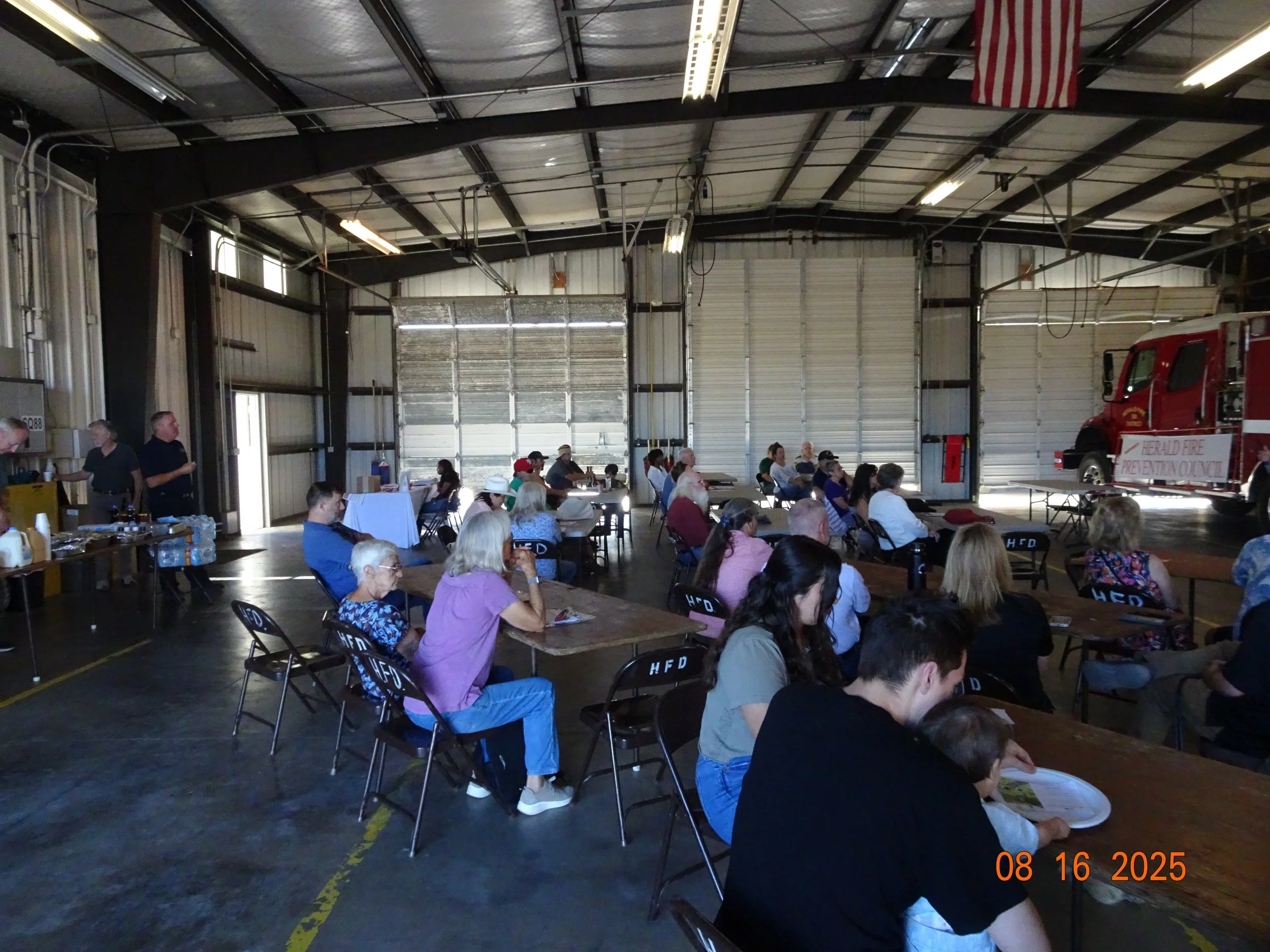
Community members gathered inside the Herald Community Fire Department station for a Fire Prevention Council breakfast meeting. Approximately 40-50 residents of all ages sit at folding tables marked with "HFD" (Herald Fire Department), engaged in discussion about fire safety and prevention. The meeting takes place in the station's apparatus bay, with white corrugated metal walls, industrial overhead lighting, and large bay doors visible in the background. The informal, neighbor-to-neighbor setting exemplifies the grassroots approach of the Herald Fire Prevention Council - bringing the community directly into the fire station to have honest conversations about the existential threat facing Herald. This is where prevention begins: neighbors sitting together at folding tables, learning that fire safety isn't just the fire department's responsibility, but a shared commitment that keeps the community viable and protected.
During my volunteer firefighter training, the instructor's words cut through the room like a blade: "If a grove of eucalyptus catches fire, do not go into it under any circumstances. You will die."
I sat there absorbing that directive - not a warning, not a caution, but an absolute order. Then I drove home through Herald, past house after house nestled among those same eucalyptus groves. Past my own home. Past the neighbor who'd run a hose to our property for six months when our well died. Past 1,700 acres of these beautiful, deadly trees that we'd all chosen to live among.
That's when the question hit me: If these trees represent such mortal danger that trained firefighters are ordered to never enter a burning grove, why did we build our homes in them?
The answer was simple and profound: because we loved them.
The Invisible Thread Holding Herald Together
Herald isn't just another rural Sacramento County community. We're the kind of place where neighbors don't just wave - they show up. When our well failed, our neighbor didn't offer sympathy; he offered his water supply for half a year. Others shared critical survival knowledge about floods, burn piles, and how to actually live here. This is a community defined by mutual aid and genuine interdependence.
But there's another form of mutual aid most residents don't see or understand: the Herald Community Fire District, and the man who holds it all together, Chief James Hendricks.
Our fire department is staffed almost entirely by volunteers - mostly young people in their early twenties who come here to train from all over Sacramento County. They arrive as kids and leave two years later as men and women who know how to run into danger when everyone else is running out. The turnover is nearly 100% every two years. There's almost no institutional memory, no crew of veterans who've been here for decades. Just constant training, constant transition, and over 500 calls a year - most of them medical emergencies.
These young volunteers are Herald's thin red line. And Chief Hendricks is the force behind their existence, the continuity in a system built on transition.
Before my training, I took the fire department for granted the way most people do. They were professionals who showed up when called. I didn't understand the bone-deep relationship between community and fire safety, the way prevention and response are two sides of the same coin.
Then I became a board member of the Herald Fire Prevention Council, and I began to understand what's really at stake.
What Happens When a Rural Community Loses Its Fire Department
Most people don't realize that without a fire department, a rural community doesn't just become less safe - it ceases to exist.
The math is brutally simple:
No fire department means no fire district.
No fire district means insurance companies won't cover properties, or premiums become unaffordable.
Uninsurable properties can't get mortgages.
Property values collapse.
People can't sell. They can't refinance. New families can't buy in.
The community enters a death spiral.
This isn't theoretical. It's happened to rural communities across California. They don't disappear overnight - they bleed out slowly as property becomes unsellable, as families who want to leave can't, as the tax base erodes, as services disappear one by one.
Chief Hendricks and the Herald Community Fire District are the only things standing between us and that fate. They're the reason Herald still exists as a viable community, why our homes have value, why insurance companies will still write policies here.
And we're asking them to hold back an existential threat - 1,700 acres of eucalyptus that firefighters are trained never to enter - with a rotating crew of volunteers in their early twenties.
The Wake-Up Call Nobody Heard
We're the only Red Flag zone designated by Cal Fire in all of Sacramento County - the highest rating for possible catastrophic fire events. We watched the Bennet area fires nearly sweep into the next county, saved only by the timely response of multiple fire agencies. We've had near-miss after near-miss.
And still, prevention remained a foreign word.
The same community that would share a well for six months somehow couldn't grasp that fuel reduction, defensible space, and fire-wise practices are the ultimate acts of neighborly care. We were asking young volunteers with two years of training to protect us from a threat that required the entire community's participation.
The equation is brutally simple: Prevention + Fire Department = Fire Safe Community.
Without that first part - without the community actively participating in prevention - even Chief Hendricks and his dedicated volunteers cannot save us. The threat is too big. The fuel load is too massive. The turnover is too constant. The risk is too high.
Prevention isn't just the best way to fight fires. In Herald, it's the only way to ensure our community survives - both physically and economically.
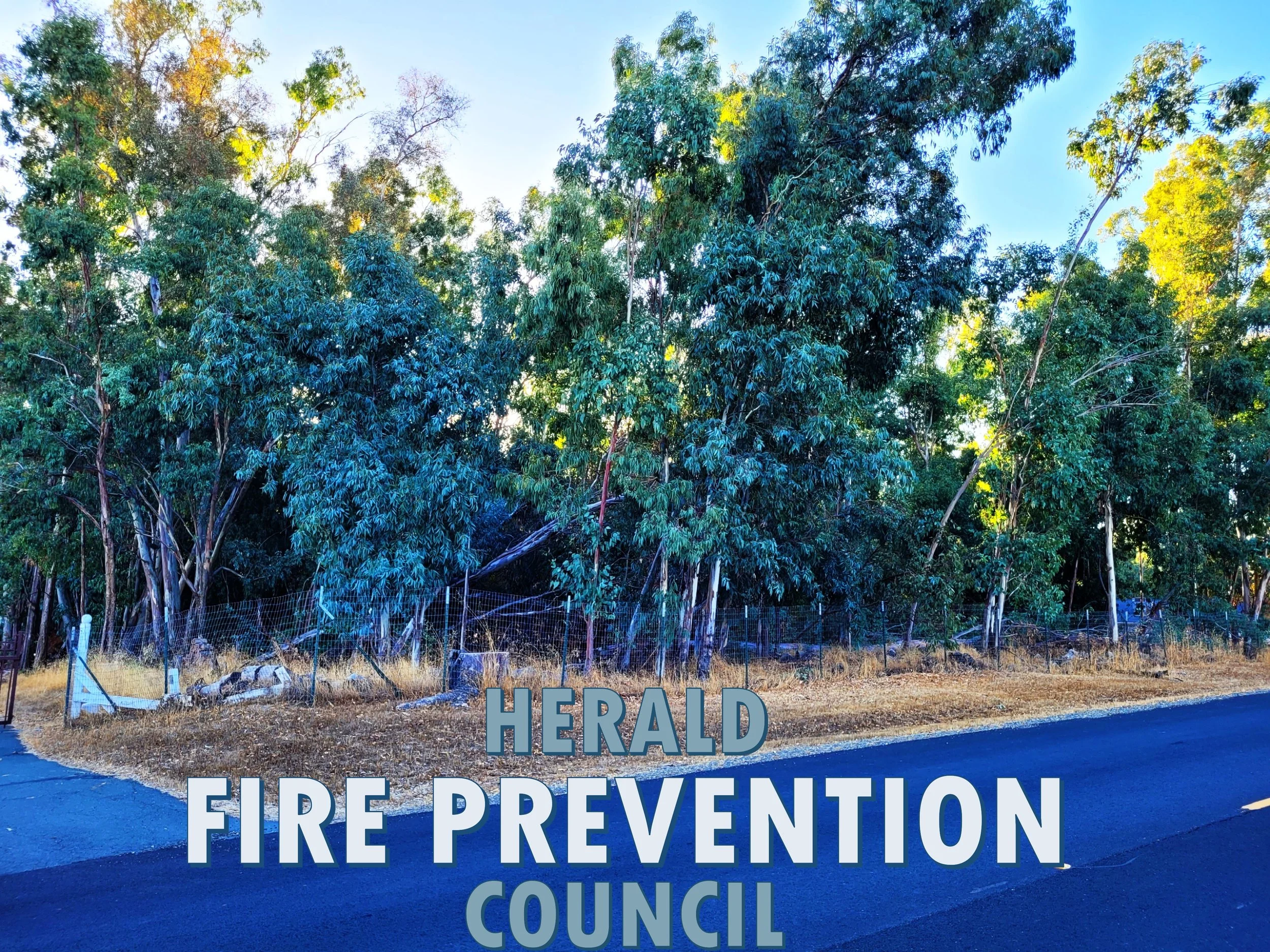
This is what 1,700 acres of eucalyptus looks like in Herald - towering trees, dense canopy, and dried grass understory creating layers of fuel. Beautiful to look at. Deadly when ignited. This is what firefighters are trained never to enter once it catches fire. And this is why prevention isn't optional.
From Kitchen Tables to Real Capacity
The Herald Fire Prevention Council started the way most important things do - with people who cared enough to act. We began with small citizen donations and a shared sense of urgency. Then Supervisor Pat Hume and Senator Niello believed in us enough to provide a $3,000 TOT grant. That seed funding allowed us to pursue 501(c)(3) status, establish a presence at Herald Day, and host community breakfasts where we could talk face-to-face with our neighbors.
We took our first swing at grant writing and got rejected. I didn't have the experience yet. But that rejection was a win - we learned what we needed to know for next time.
Then things started accelerating. We secured a $10,000 per month Google Ad grant. We built a new website that's about to launch. We developed a strike team initiative and a community Firewise initiative that will transform how we approach fire safety in Herald.
Now, we're standing at the precipice of capacity growth. Everything we've built - every conversation, every breakfast, every small donation, every lesson learned - has brought us to this moment where we can actually scale our impact to match the size of the threat.
We're building the prevention infrastructure that will lighten the impossible burden we've placed on Chief Hendricks and his young volunteers. We're creating the community capacity that will ensure Herald doesn't just survive the next fire season, but survives as a viable community for generations.
It's daunting. It's fulfilling. And it requires all of us.
The Golden Paradox Demands a Golden Response
Here's the paradox we live with every day: The same qualities that make Herald beautiful and worth protecting - the trees, the rural character, the tight-knit community that shares wells and survival knowledge - are inseparable from the existential threat we face.
Young people come here to train as firefighters because Herald needs them. They leave two years later having learned what it means to serve a community in its most vulnerable moments. Chief Hendricks has built a training ground that serves all of Sacramento County while protecting our small corner of it.
But that paradox also contains our salvation. The same ethic of mutual aid that defines us can extend to fire prevention. The neighbor who shares water can also create defensible space. The community that shows up for each other can show up for Firewise practices. The appreciation we have for our volunteer firefighters can translate into the prevention work that makes their impossible job merely difficult.
The Herald Fire Prevention Council has evolved from a concept to a functioning organization with real infrastructure and expanding capacity. But infrastructure isn't enough. We need the community to evolve with us.
Because the alternative - the slow death spiral of a community without a fire district - isn't something any of us can afford.
What We're Asking For
As we launch our new initiatives and activate our new resources, we need you to engage:
Donate: Even small contributions compound into real capacity. Every dollar goes directly toward reducing the fuel load and building the prevention infrastructure that keeps Herald viable - both as a safe community and as a place where property maintains its value.
Volunteer: We need hands, minds, and hearts. Whether it's event support, outreach, or program development, there's a role for you. Think of it as serving alongside Chief Hendricks and his volunteers, just in a different capacity.
Join Our Firewise Initiative: This community-driven program will transform how we approach fire safety at the neighborhood level. It's how we reduce the burden on our volunteer fire department while protecting our community's economic viability.
Engage with Our New Website: When it launches, visit it, share it, use it as a resource. Our $10K monthly Google Ad grant will drive people to that site - we need it to convert awareness into action.
Spread the Word: Talk to your neighbors. Share our posts. Make prevention a normal part of conversations in Herald. Help people understand that prevention isn't just about fire safety - it's about community survival.
The Difference Between Then and Now
Before my firefighter training, the fire department was something I took for granted. Now I understand that Chief Hendricks and his rotating crew of young volunteers are literally the only reason Herald can exist as an insurable, viable community.
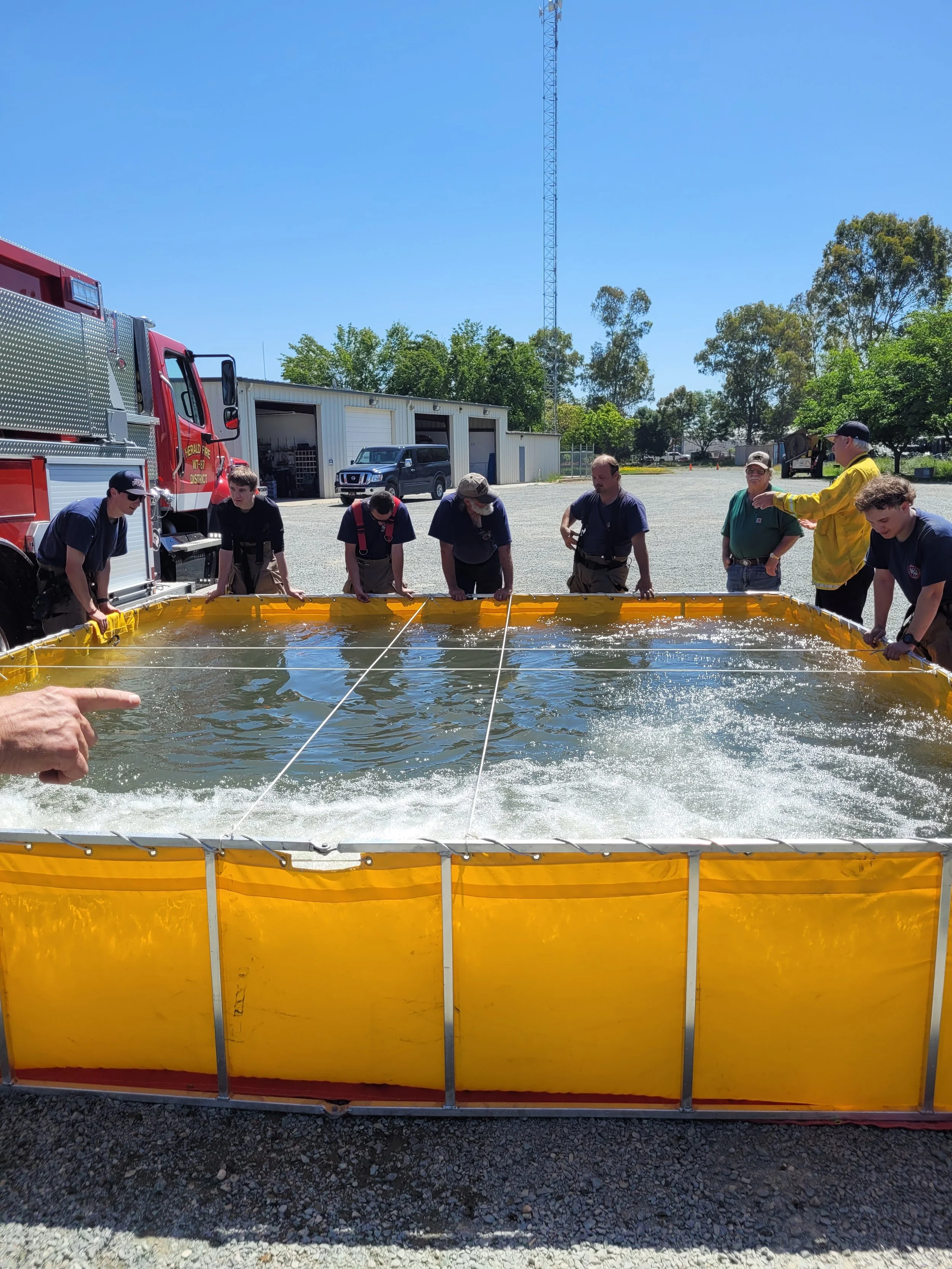
Herald's volunteer firefighters training in water relay operations - essential skills for protecting a community surrounded by 1,700 acres of eucalyptus.
Before the Herald Fire Prevention Council, we had good intentions and scary near-misses. Now we have infrastructure, initiatives, and the capacity to actually change outcomes.
The Golden Paradox hasn't gone away - we still live among 1,700 acres of trees that could kill us all, and we still love them. But we're no longer passively hoping for the best or asking impossibly young volunteers to do what only the entire community can accomplish together.
We're building the prevention capacity that matches the scale of the threat. We're ensuring that Herald doesn't just survive the next fire season, but survives as a community - period.
The question is no longer whether the Herald Fire Prevention Council can survive. The question is whether we can rise to meet this moment - together.
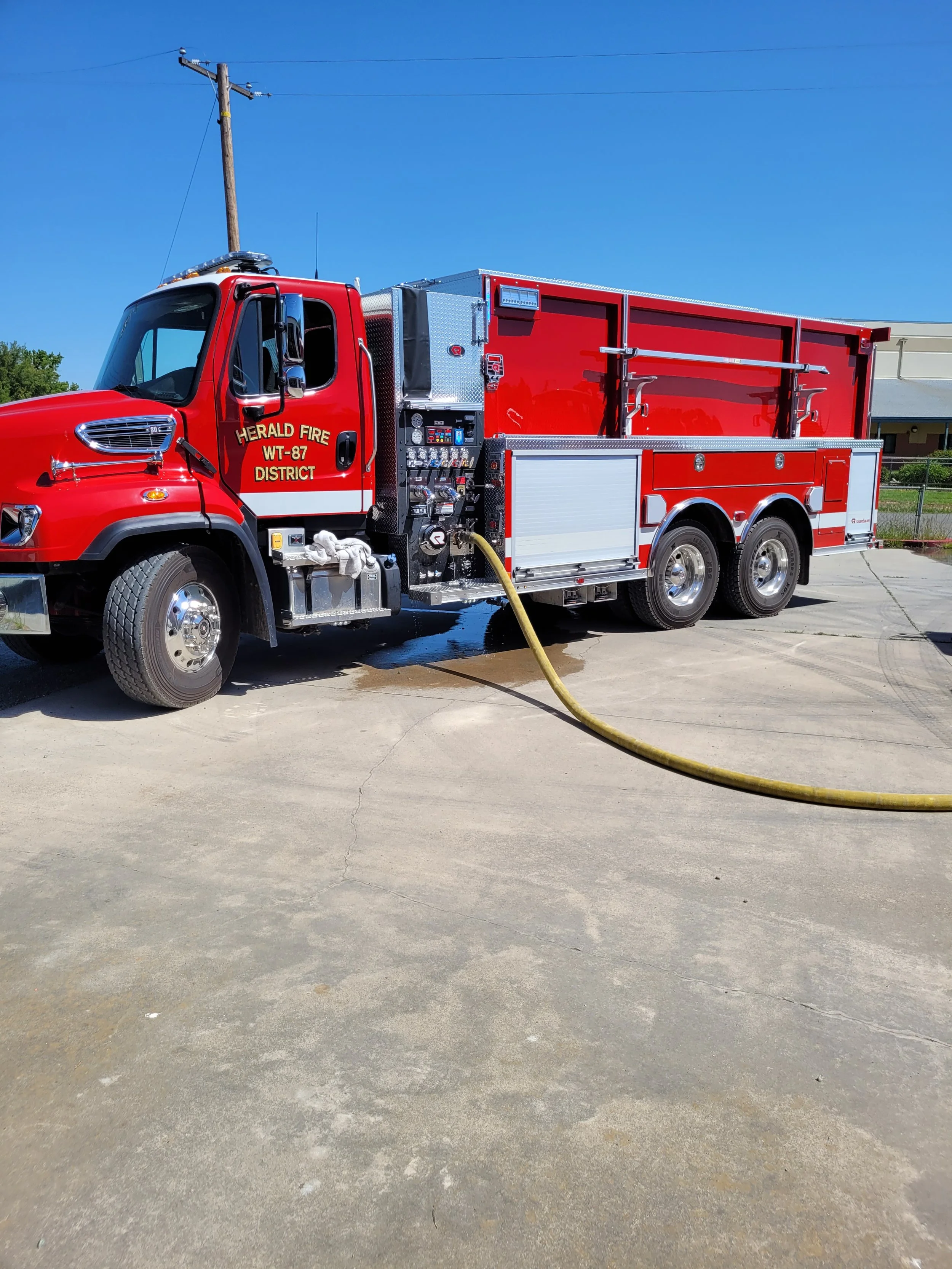
Type 3 wildland fire engine - built for vegetation fires, equipped with water tank and hose reels - parked at our volunteer fire station. When eucalyptus groves ignite in Sacramento County's only Red Flag zone, this is what responds. Not a fleet of engines. Not career firefighters with decades of experience. Young volunteers, many still in their early twenties, operating equipment like this to hold back an existential threat. It's a powerful reminder of why the Herald Fire Prevention Council exists: to build the community capacity that ensures these volunteers aren't facing impossible odds alone.
Because prevention isn't what the fire department does for us. It's what we do for each other, and what we do to ensure that the young volunteers who protect us, and the Chief who leads them, aren't being asked to do the impossible alone.
To learn more about the Herald Fire Prevention Council, make a donation, or get involved with our Strike Team and Firewise initiatives, visit our website Heraldfirecouncil.org or contact us at Info@Heraldfirecouncil.org. Chief James Hendricks and the Herald Community Fire District keep us safe. The Herald Fire Prevention Council ensures we stay viable. Together, we ensure Herald survives.
